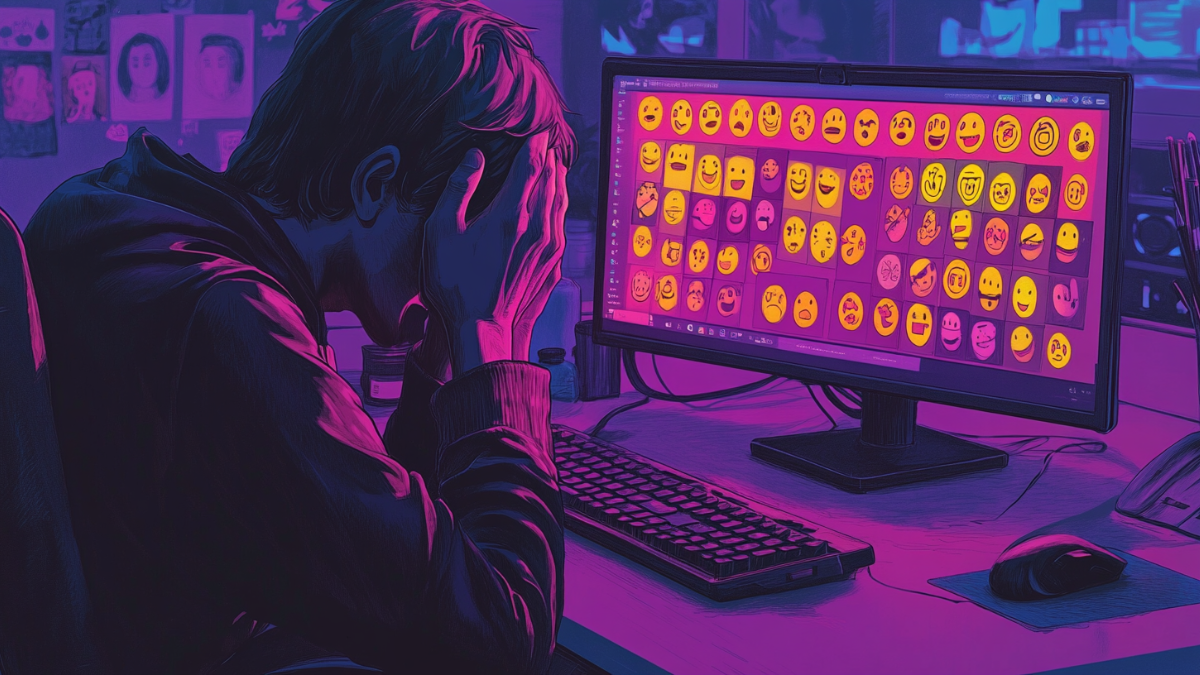
Linguists worldwide have issued a dire warning: the overuse of emojis has left the English language in a state of irreversible decline. Once the tool of millennials trying to convey emotions through minimal effort, emojis have now overtaken words as the dominant form of communication, leaving grammar, spelling, and even punctuation fighting for relevance. 😬
“We’ve officially entered the Emojiocene Epoch,” declared Dr. Linda Syntax, a professor of linguistics at Oxford, who communicated her entire press statement using a slideshow of crying faces, fire symbols, and thumbs-up emojis. “At this point, 😔📚.”
Language Devolves into Pictorial Pandemonium
The rise of emojis, originally intended as a playful supplement to text, has spiraled out of control. According to a recent study, 82% of text-based conversations now consist entirely of emojis. Sentences like “Let’s meet for coffee at noon” have been replaced by a simple string of ☕️🕛👋, which researchers warn lacks the nuance and subtlety of proper language.
“This isn’t just about losing words—it’s about losing culture,” said Dr. Syntax, visibly distressed. “Imagine Shakespeare’s Romeo and Juliet rewritten as 💔🔪💀😭.” Experts believe that if the trend continues, literature, poetry, and even legal contracts could one day be reduced to incomprehensible hieroglyphs, like 📜🤝⚖️.
The Emoji Economy: Words Are Expensive, Faces Are Free
Proponents of the emoji revolution argue that the shift is just linguistic evolution in action. “Why bother with complex sentence structures when a single 😂 can convey everything from joy to existential despair?” asked tech futurist Devon Smirk, author of Texting Through Time. Smirk predicts that within a decade, written language could be obsolete. “We’ll just send each other vibes,” he said. “Like, literal vibes. 🔮.”
However, critics argue that emojis often create more confusion than clarity. A 2023 lawsuit involving a landlord and a tenant hinged on the interpretation of a single smiley face. “Was it a friendly smile or a sarcastic smile?” the judge pondered, sparking three days of heated emoji analysis.
The verdict? Mistrial due to “irreconcilable emoji interpretation.”
The Generational Emoji Divide
The emoji apocalypse has also exacerbated generational tensions.
Boomers, who still prefer full sentences and occasionally the odd winking face 😉, find themselves bewildered by Gen Z’s cryptic use of skull emojis 💀 (usually indicating laughter, not death). Meanwhile, Gen Z accuses Boomers of “emoji misuse” for their liberal deployment of ellipses and random clapping hands 👏 between words.
“Every time my dad sends me a text ending in 🎉🛠️🐕, I feel like I’m deciphering ancient runes,” said one exasperated teenager.
What Comes After Emojis?
As emojis continue to multiply, some experts are already predicting the next stage of linguistic entropy. “GIFs are the logical successor to emojis,” explained Smirk. “Why say ‘I’m angry’ when you can send a looped clip of a raccoon throwing a trash can?” Others predict we will regress even further, reverting to a system of grunts, gestures, and TikTok trends to communicate basic needs.
For now, Dr. Syntax and her colleagues remain committed to reversing the damage. “We’re launching a global campaign to teach children how to use words again,” she said, holding up a flashcard with the word “hello” written in Comic Sans. “The battle isn’t over. But let’s be honest: 😬.”